
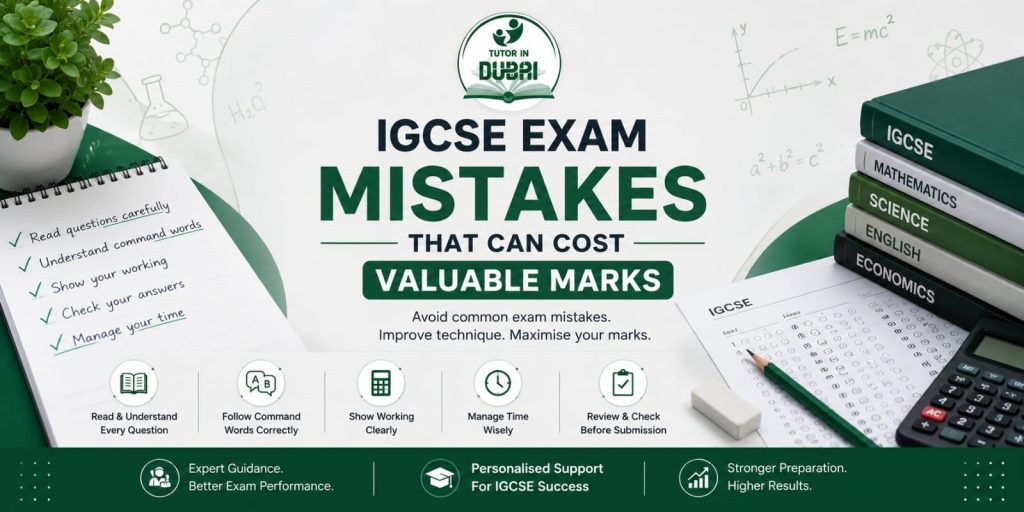
Knowing the syllabus is only part of doing well in an IGCSE examination. A student can spend weeks on preparation, yet still lose marks because of avoidable mistakes. There are several reasons that can make a real difference to the final result. The frustrating part is that many of these mistakes have little to do with intelligence or effort. No matter what subject your child is preparing for, identifying these mistakes before the exam can help protect marks that are already within reach.
For students who need additional guidance, Tutors in Dubai can also provide focused practice on the areas where marks are commonly lost.
IGCSE Exam Mistakes That Can Cost Valuable Marks
The following are the IGCSE exam mistakes that can cost valuable marks
1. Reading the Question Too Quickly
A student sees a familiar topic and immediately starts writing. That can be a costly habit. An IGCSE question may contain several instructions, conditions, or pieces of information that need to be considered before answering. Therefore, encourage your child to pause before answering. Look for exactly what the question requires, then respond accordingly.
2. Ignoring Command Words
Words like describe, explain, calculate, compare, evaluate, discuss, and justify are not interchangeable. They tell students what type of response is expected. A question asking students to explain something generally requires more than simply naming it. A question asking them to compare usually requires similarities or differences to be clearly established.
Students who understand the content but overlook the command word can give technically correct information without fully answering the question. This is an area where Private Tutors in Dubai can help students practise responding to different question styles rather than simply memorising content.
3. Giving Answers That Are Too Short
Some students believe that if they know the answer, writing one sentence is enough. Not always. For longer-mark questions, examiners may be looking for several elements. A short statement may demonstrate some knowledge but fail to provide the explanation, evidence, reasoning, or development needed for full marks.
This doesn’t mean students should write unnecessarily long answers. They should provide enough relevant detail to satisfy the question. Learning how much information a particular question requires is an important part of examination preparation.
4. Losing Marks Through Careless Calculations
In numerical subjects, a student may understand the method perfectly and still lose marks because of a small error. Common examples include:
- Copying a number incorrectly
- Forgetting a negative sign
- Using the wrong unit
- Rounding too early
- Making a calculator entry error
- Writing the wrong final value
These mistakes can be particularly frustrating because the student may know exactly how to solve the problem. Practising under timed conditions can help improve accuracy without sacrificing speed.
5. Forgetting Units and Labels
A numerical answer isn’t always complete without the correct unit. Students can become so focused on reaching the final number that they forget to include metres, centimetres, kilograms, seconds, percentages, or other required units. The same applies to graphs and diagrams.
Encourage your child to check whether every answer requiring a unit, label, scale, or appropriate notation includes it. These small details can protect valuable marks.
6. Not Showing Working
In subjects involving calculations, jumping directly to a final answer can be risky. If a student makes an error but has shown a correct method in their working, there may be opportunities for method marks depending on the question and mark scheme.
Writing down the relevant steps also makes it easier for students to spot their own mistakes. This is particularly important when a question involves several stages. A clear working process is not wasted time, it can be part of a strong examination strategy.
7. Spending Too Long on One Question
Some students find a difficult question and refuse to move on. Five minutes become ten. Ten become fifteen. Meanwhile, easier marks elsewhere on the paper remain unanswered. Students should learn to recognise when a question is consuming too much time. If they are genuinely stuck, they can move ahead and return to it later if time allows.
Tutors in Dubai can help students practise this skill by using timed papers and teaching them how to divide their available time sensibly.
8. Leaving Questions Blank
A difficult question can feel intimidating, but leaving it completely blank guarantees no marks. Even when students aren’t certain of the final answer, they may be able to write something relevant, show a calculation, identify a formula, or provide part of the required explanation.
The exact marking approach varies by question, so students should follow the instructions and use their knowledge wherever possible. A blank space has no chance of earning credit.
9. Memorising Without Understanding
Memorisation has its place in IGCSE preparation. Students may need to remember formulas, terminology, definitions, processes, or key facts. But memorisation alone can become a problem when examination questions are presented in unfamiliar ways.
A student may recognise a textbook example but struggle when the same concept appears in a new context. Understanding allows students to adapt. This is why revision should include unfamiliar questions rather than relying exclusively on repeated examples.
10. Using Practice Papers Without Reviewing Mistakes
Completing ten past papers isn’t automatically better than completing five. What matters is what happens afterwards. Students should examine their incorrect answers and ask:
- What caused the mistake?
- Was it a knowledge gap? A calculation error? Misreading the question? Poor timing?
- Without this analysis, students can repeatedly make the same mistakes.
A good revision routine therefore includes three steps: Attempt → Check → Correct The third step is often the one students skip.
How the Right Tutor Can Improve Exam Technique
Academic support isn’t only about explaining chapters. The Best Tutors in Dubai can help students understand how to turn knowledge into marks. That may involve analysing mark schemes, practising command words, completing timed questions, reviewing common errors, and improving written responses.
Additionally, a tutor can also observe how a student works. Do they rush? Overthink? Skip working? Struggle to organise longer answers? Once these habits are identified, they can be addressed deliberately.
Conclusion
IGCSE examinations test knowledge, but they also test how effectively students can apply that knowledge under pressure. If your child understands the syllabus but continues losing marks through exam technique, targeted support may be worthwhile.
Tutors in Dubai can help students practise under realistic conditions, while Private Tutors in Dubai can focus on individual weaknesses instead of following a one-size-fits-all revision plan. For parents searching for the Best Tutors in Dubai, look beyond subject knowledge alone. Consider tutors who can analyse mistakes, strengthen examination technique, and help students become more confident and independent when facing an IGCSE paper.
FAQs
1. What are common IGCSE exam mistakes?
Misreading questions, ignoring command words, poor time management, careless calculations, incomplete answers, and failing to review mistakes are common issues.
2. Can Tutors in Dubai help with IGCSE exam technique?
Yes. Tutors in Dubai can provide timed practice, feedback, past-paper analysis, and guidance on answering different question types.
3. Are Private Tutors in Dubai useful for strong students?
Absolutely. Private tutors in Dubai can help capable students refine examination technique, target lost marks, and work towards higher grades.
4. What should I look for in the Best Tutors in Dubai?
Look for relevant IGCSE experience, strong subject knowledge, personalised teaching, regular feedback, and an emphasis on both understanding and exam performance.